
The endless struggle of survival in a world that is not designed for all people is problematic. As a member of College Sports Communicators’ Inclusion Committee, we are often told by Chair Scottie Rodgers, the Vice President for Communications at the Cotton Bowl Athletic Association, “The words may change but the work continues” for building inclusivity within athletic communications.
Tava Health, on their blog, emphasizes the need to create an inclusive workspace for specifically neurodivergent employees. As of a 2021 study by the National Library of Medicine, the unemployment rate for autistic adults is approximately 40%.
Many estimates say that the rate is significantly higher. Higher rates are attributed to a higher rate of diagnosis within autistic adults, and more specifically, adult autistic women. Motivity estimates that between 50% to 90% of autistic adults are either underemployed or unemployed. Autism Society estimates, as of early 2025, that 85% of autistic college graduates are either unemployed or underemployed.
The first step to doing so, is building the inclusive spaces within athletic administration.
Office and Work Spaces
Office spaces vary based on building design and the staffing needs of the department.
Some individuals get single offices, some have group workspaces. The essence of athletic communications, and athletics in general, is collaborative. Moreso than many other professions. How can inclusive spaces be created in a profession that is so collaborative?
The first step that Tava Health suggests is implementing flexible work environments. In an office setup where cubicles are the setup, having quiet spaces is one step in a direction encouraging inclusivity.
Neurodivergent employees may be easily distracted by outside conversations, while some may be easily overstimulated by the excess noise.
Fluorescent lighting has been noted as a sensory issue as well, due to the flickering of the tube lights. Sometimes, the color or brightness of the light may be a problem as well.
For those with mobility issues, the layout and spacing of an office might pose issues with navigating with wheelchairs, canes or crutches.
Location
If lighting happens to be an issue, natural lighting in offices may be the route to go.
For individuals with mobility issues, elevators and lifts are a necessity. Buildings that were built prior to 1990 may lack elevators in the building. The Americans with Disabilities Act mandated elevators or lifts in most multi-story facilities, if they meet specific requirements.
In sports specifically, press boxes are listed in the accessible routes section. Press boxes are exempt if they fall under two criteria:
- The individual box is less than 500 square feet, including all surrounding space of that particular box
- The box is freestanding or built into bleachers with entry on one level.
Burnout
In sports, all workers understand that there are expectations on when and where to be. This is specifically the events we are expected to work and cover. This is something that all workers, regardless of ability are expected to meet. But the bigger question surrounding flexible work schedules is avoiding burnout.
In ADU’s Division I Administrative Burnout, Exhaustion & Disengagement 2-part article, Michael Cross, commissioner of the Southern Conference assesses “The 5-10 year and 11-20 year professionals are caught in the worst possible position — as they acquire the experience to truly make a difference, the new realities of college athletics undervalue those skills. The veterans who remain after 20 years represent the survivors – they’ve either learned to work within the system, have seen enough to know that regardless of what is thrown at them the can still persist, and have likely risen to leadership positions where they have more agency, better compensation and/or have made peace with the fundamental changes in college athletics.”
Technology
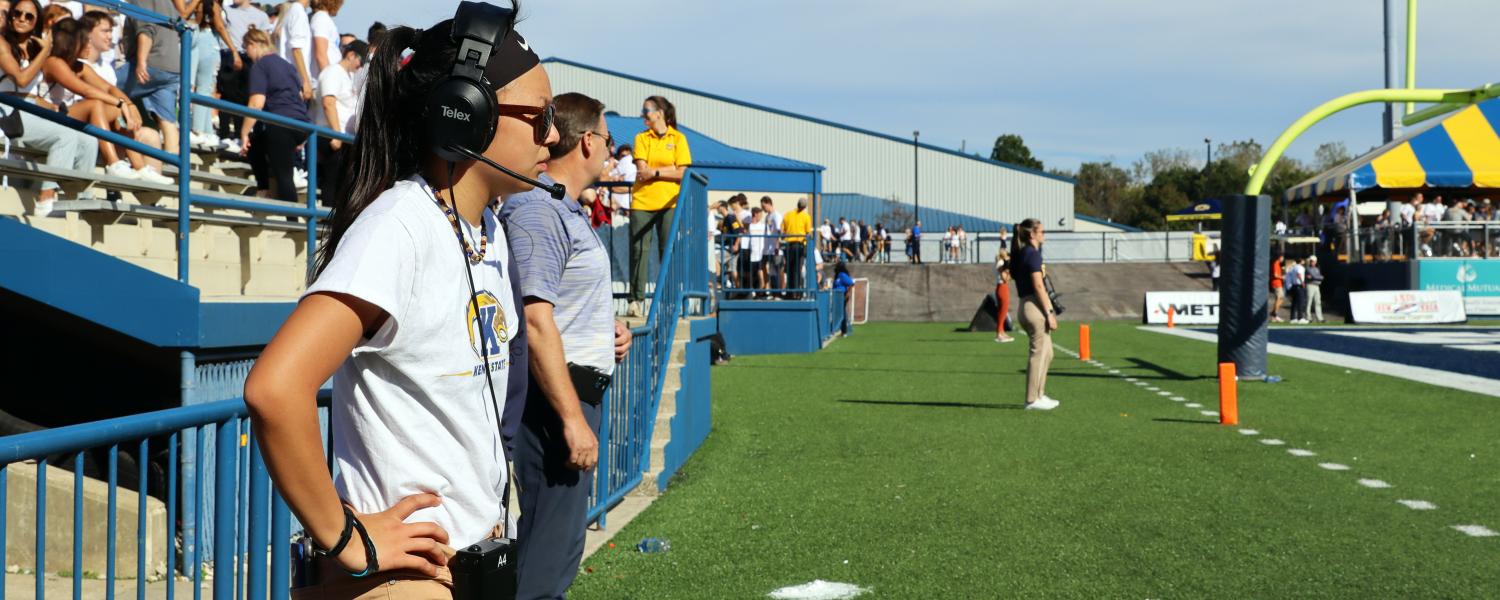
The sensory stimulation and auditory processing may prove to be difficult for many. Providing closed-circuit communications systems for people in loud environments via noise-cancelling headsets is one way to achieve this.
The adaptation to LED lighting in venues has encouraged more teams to use lighting effects during sporting events. People who have sensitivity to strobing lights require notification that it is used and when it is used to prevent medical emergencies.
Why should we do this
According to a CDC report in 2024, over 70 million U.S. adults report having a disability. That’s over 1 in 4 adult Americans. This number may be higher or lower, based on how “disability” is defined. The rate is higher in individuals over 65, where over half of Americans 65+ report having a disability.
The changes in neurodivergent diagnostic criteria and the growth of social media connections between isolated populations is showing a surge of autism diagnoses between 1 in 150 in 2000, to 1 in 36 in 2020.
It’s still known that male individuals are still about 4 times as likely to be diagnosed with autism as a woman. (https://jamanetwork.com/journals/jamanetworkopen/fullarticle/2825472)
Post Traumatic Stress Disorder is also seeing a rise in diagnoses, with one study in 2024 showing an upward trend with rates increasing from 3.4% of the American population in 2017-18 to 7.5% in 2021-22.
Building a department with inclusivity at its core, strengthens the entire organization. A McClean & Company report highlights organizations who prioritize neuroinclusive leadership can better meet the evolving workforce demands of tomorrow.
 Cadence Pierce - Portfolio